
If you’ve ever bought a cute cat toy and watched it get destroyed in minutes, you’re not alone.
I live in Japan with two cats, now over 10 years old.
Over the years, I’ve tried many different toys—from simple feather sticks to electronic gadgets.
Most of them didn’t last long.
But some taught me something important about how cats really play.
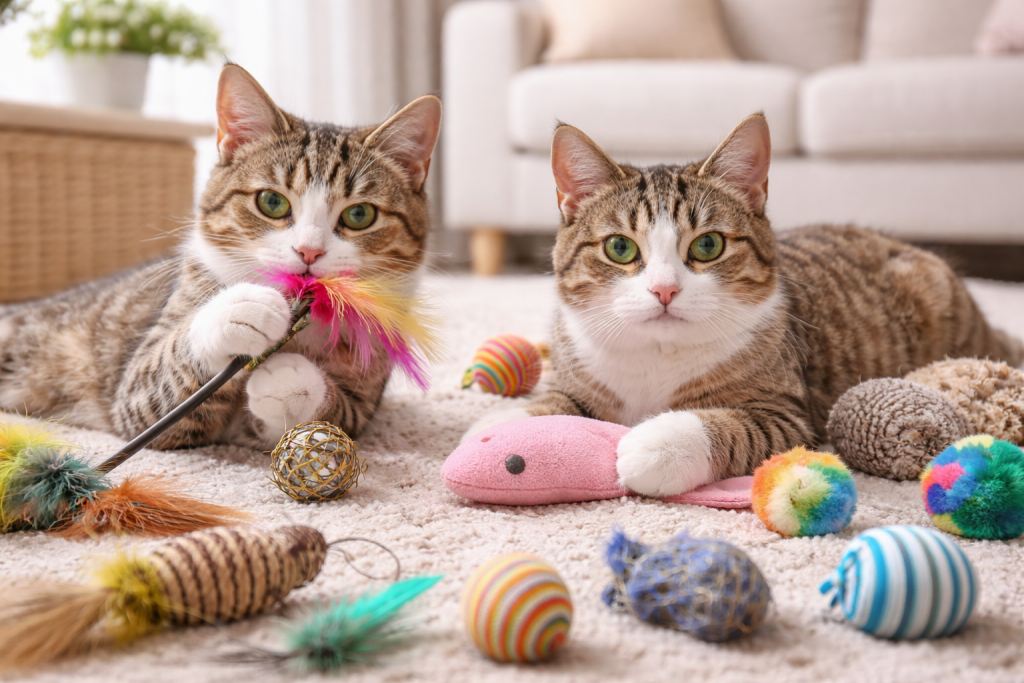
The Problem with Popular Cat Toys
In Japan, many affordable cat toys are sold in supermarkets.
A common type is:
- A stick with feathers or fur attached at the end
They are fun—at first.
But here’s what usually happens:
- Cats jump, bite, and tear the feathers apart
- Parts get ripped off quickly
- Small pieces can become a safety concern
Because of this, I learned to put these toys away after playtime.
If left out, my cats would:
- Stare at them
- Suddenly attack
- Try to chew or swallow parts
A Toy That Surprised Me: The Fish Plush
One of the most interesting toys I tried was a fish-shaped plush.
Inside, it had:
- A zipper
- Space to add catnip
I waited until my cats were older (around 2 years old) before introducing it.
The result was unexpected.
They didn’t just play with it.
They:
- Hugged it
- Kicked it
- Even slept with it like a pillow
Seeing a cat cuddling a fish almost the same size as its body is something you don’t forget.
Electronic Toys: Fun but Temporary
Like many people, I don’t have time to play all day.
So I tried automatic toys.
One of them was:
- A round device
- A hidden wand rotates under fabric
- Creates unpredictable movement
At first, it worked very well.
My cats:
- Chased it
- Got excited
- Stayed engaged
But over time, something changed.
Around age 5–6, they started:
- Watching instead of chasing
- Losing interest quickly
It seems that novelty wears off.
What My Cats Love the Most (Unexpected Answer)
After trying many products, the favorite “toys” in my home are surprisingly simple.
- Rubber bands (for chewing and chasing)
- Drawstrings from sweatpants or hoodies
These are not even sold as toys.
But my cats:
- Bite them
- Chase them
- Stay interested longer than expensive products
A Small Warning About Safety
Simple objects can be fun, but they need caution.
Always:
- Supervise playtime
- Avoid small parts that can be swallowed
- Store toys when not in use
Cats are curious—and sometimes too brave.
What I Learned from Living with Cats in Japan
In Japan, homes are often compact.
That changes how cats play.
Instead of large spaces, cats use:
- Corners
- Floors
- Small moving objects
Toys don’t need to be expensive.
They need to match your cat’s instincts.
Related Guides
If you’re building a better environment for your cat, these may help:
- → Best Cat Toys for Indoor Kittens (2026 Guide)
- → How to Stop Kitten Biting (2026 Guide)
- → Cat Nail Care: What I Learned Living With Two Cats in Japan
Final Thoughts
Expensive toys don’t always mean better play.
In my experience, cats prefer:
- Movement
- Texture
- Interaction
Sometimes, the simplest things win.
One Question for You
What does your cat love the most?
Is it a store-bought toy—or something unexpected like mine?
I’d love to know how cats play in your country.