
Siberian cats are known for their thick, fluffy coat and friendly personality.
Siberian Cat Personality and Traits
Among popular cat breeds in Japan, some stand out for their size and background.
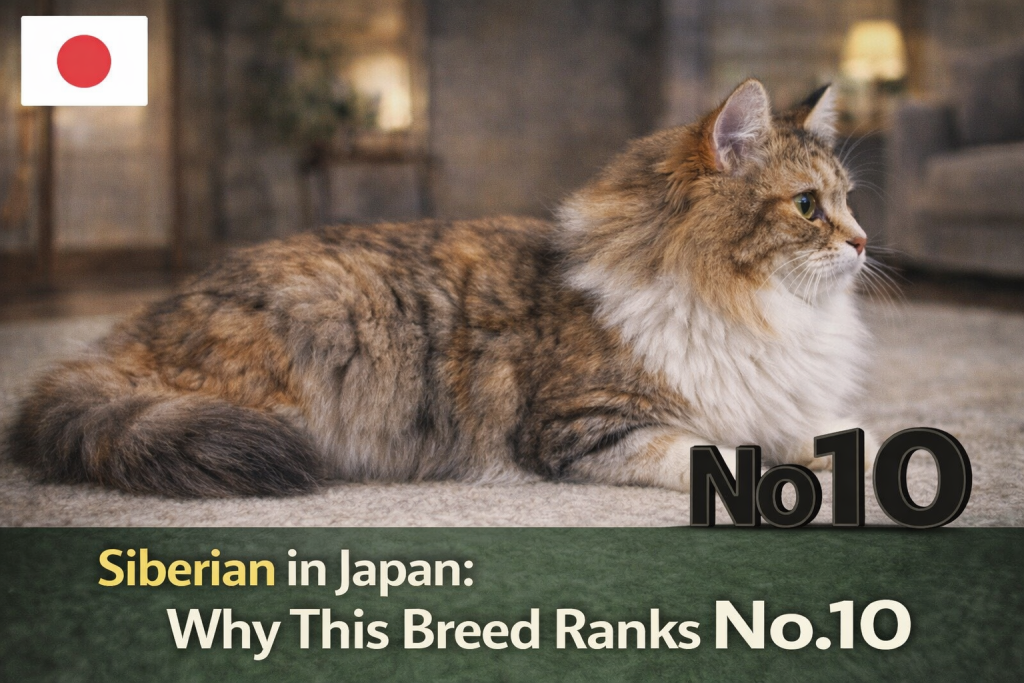
👉 Siberian
This breed is known for its strong body, thick coat, and long history in cold regions.
What Is a Siberian?
The Siberian is a large, long-haired cat known for:
- thick triple-layered coat
- strong, muscular build
- round yet powerful appearance
It is considered a natural breed rather than one heavily shaped by modern breeding.
Origin and Historical Background
The Siberian cat is believed to originate from:
👉 northeastern Russia
It is often described as a native cat of the region.
There are references suggesting:
- cats of this type existed as early as around the 11th century
- they developed naturally in harsh climates
Because of this long history, the breed is sometimes described as:
👉 a “living fossil” among domestic cats
This does not mean unchanged, but it reflects its deep historical roots.
A Cat Connected to Russian Culture
Siberian cats are often associated with Russian households and culture.
They have been widely kept in the region for generations,
and are sometimes mentioned in connection with public figures or well-known individuals in Russia.
However, such details vary and are not always consistently documented.
Why It Is Popular in Japan
Despite its large size, the Siberian attracts attention in Japan for several reasons:
- impressive and powerful appearance
- natural breed with long history
- balanced personality
It offers a different appeal compared to smaller or more compact breeds.
Coat Structure and Characteristics
The coat is one of the most important features.
Triple Coat Structure
- guard hair (outer layer)
- awn hair (middle layer)
- dense undercoat
This structure helps protect the cat from extreme cold.
Coat Texture and Seasonal Changes
- thick and water-resistant
- becomes heavier in winter
- lighter in warmer seasons
This seasonal change is part of its natural adaptation.
Coat Colors and Patterns
Siberians come in a wide range of colors.
Common Colors
- brown tabby (very common)
- black
- white
- blue (gray)
- red / cream
Patterns
- tabby
- solid
- bicolor
- tortoiseshell
Because of natural development, variation is wide.
Personality and Behavior
Siberians are often described as:
- calm but capable
- confident
- adaptable
They are not usually passive, but also not overly demanding.
Activity Level
- moderate activity
- capable of climbing and movement
- balanced energy
They are physically strong but not constantly hyperactive.
Living With a Siberian in Japan
In Japan, where indoor living is common:
- space may be limited
- seasonal temperature changes are significant
Siberians can adapt, but there are considerations:
- larger body requires space
- thick coat may be affected by heat
- airflow and cooling are important in summer
Grooming and Care
Because of the coat:
- regular brushing is recommended
- shedding varies by season
- maintenance is moderate to high
Is This Breed a Good Choice?
It may be a good fit for:
- people who like large cats
- those interested in natural breeds
- owners who can manage grooming
Environment and climate should be considered.
How It Compares to Other Cats in Japan
Compared to:
- Norwegian Forest Cat (No.5)
👉 similar in size, but different origin and coat texture
Compared to:
- Ragdoll (No.6)
👉 more physically robust and less “relaxed”
Compared to:
- Mixed-Breed Cats (No.1)
👉 more consistent in size and coat structure
Related Articles
- Most Popular Cat Breeds in Japan
- Norwegian Forest Cat in Japan
- How Much Does It Cost to Own a Cat in Japan?
FAQ
Where do Siberian cats come from?
They are associated with northeastern Russia and are considered a natural breed.
Are Siberians suitable for hot climates?
They can adapt, but their thick coat means cooling and airflow are important.
Do Siberians require a lot of grooming?
Moderate to high. Their thick coat needs regular maintenance.
Final Thoughts
The Siberian represents a different kind of appeal:
👉 large
👉 natural
👉 historically rooted
It stands apart from modern or compact breeds,
offering a strong presence shaped by environment and time.