
Letting a cat outside may feel natural.
But is it actually safe in Japan?
Have you ever wondered what really happens once a cat leaves the house?
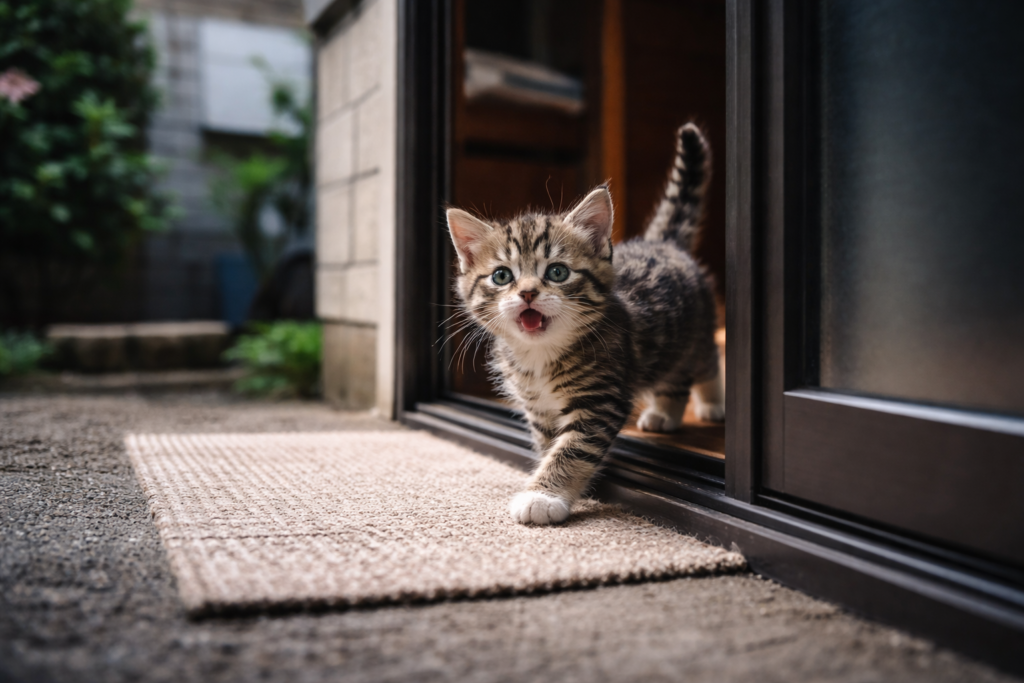
🟡 Conclusion: Outdoor Life Is Risky in Japan
In most cases, letting your cat outside in Japan is not recommended.
The risks are not always visible at first—but they are there.
🏠 How Far Do Cats Actually Roam?
Cats usually move within a limited range.
- Around 100 to 350 meters
It sounds close.
But once they go beyond that familiar area, returning home becomes difficult.
Would your cat be able to find its way back every time?
Not always.
⚠️ Risk 1: Disease Exposure
Outside, your cat may meet other animals.
Especially stray cats.
That contact alone can increase the risk of:
- Infections
- Parasites
- Skin problems
Even if it looks harmless, the risk is real.
⚠️ Risk 2: Territorial Fights
Cats protect their territory.
If your cat enters another cat’s area, conflict can happen.
Indoor cats are usually not prepared for this.
Gentle cats, in particular, are often at a disadvantage.
⚠️ Risk 3: Traffic Accidents
Japan has many narrow streets—but cars are everywhere.
Cats are active at night.
What happens if a cat suddenly runs out in the dark?
Drivers may not notice in time.
⚠️ Risk 4: Getting Lost
Cats depend on familiar smells and space.
Once outside their known area, they may not return.
Especially indoor cats.
⚠️ Risk 5: Animal Control in Japan
This is something many people outside Japan may not know.
If a stray cat or dog is found, it may be taken by a government facility.
After being taken in, animals are often not kept long.
In many cases, they are euthanized.
Years ago, stray animals were more common.
Today, seeing even one can be noticeable.
So what would happen if your cat is mistaken for a stray?
It is not impossible.
This is why responsible ownership matters so much.
🛡️ What You Can Do Instead
If letting your cat outside is risky, what can you do?
Here are practical steps you can take:
① Secure doors and windows
Cats are curious.
Have you noticed how quickly they move when a door opens?
Small gaps are enough for escape.
💡 Optional: Professional Escape Prevention Solution
If you want to take escape prevention more seriously, there are also specialized products available in Japan.
One option is “Nyanguard,” a brand focused on cat escape prevention systems.
They use solid Japanese cypress wood, crafted by professionals, combining both safety and aesthetic design.
Many of their products are tension-mounted, meaning they can be installed without damaging walls—making them suitable even for rental homes.
If you’re interested, you can check their official site here:
👉 https://nekokobo.jp/
② Use a GPS tracker
A simple but effective tool.
There are two types:
- Collar or accessory type
- Microchip-style (inserted under the skin)
The collar type is common and easy to start with.
GPS will not prevent escape—but it can help you find your cat faster.
If you want a reliable GPS collar for your cat, the official MiTag is one of the most trusted options. It’s lightweight, accurate, and designed specifically for pets, making it ideal for keeping track of your cat’s safety outdoors. 👉 Official product page: https://mitag.jp/
③ Keep vaccinations up to date
If your cat ever goes outside—even briefly—
vaccination becomes very important.
It reduces the risk of serious illness.🐱 Cat Vaccinations: 3‑way vs 5‑way
| Category | 3‑way Vaccine | 5‑way Vaccine |
|---|---|---|
| Diseases Covered | • Feline Viral Rhinotracheitis (FVR) • Feline Calicivirus (FCV) • Feline Panleukopenia (FPV) | • All diseases in the 3‑way vaccine + Feline Leukemia Virus (FeLV) + Chlamydia felis |
| Recommended For | Indoor-only cats | Outdoor cats, multi-cat households, rescued cats, higher-risk environments |
| Vaccination Schedule (Kittens) | 8 weeks → 12 weeks → (optional 16-week booster) | Same as 3‑way |
| Vaccination Schedule (Adults) | First year: 2 doses After that: once a year (or every 2–3 years depending on antibody titer) | First year: 2 doses After that: once a year (Chlamydia immunity declines faster) |
| Cost in Japan (per dose) | ¥3,000–¥5,000 (approx. $20–$33) | ¥5,000–¥8,000 (approx. $33–$53) |
| Total First-Year Cost | ¥6,000–¥10,000 (approx. $40–$67) | ¥10,000–¥16,000 (approx. $67–$107) |
| Advantages | Covers core diseases; lower risk of side effects | Broader protection for high-risk cats |
| Disadvantages | Does not protect against FeLV or Chlamydia | Higher cost; slightly higher chance of side effects |
🦠 Details of Covered Diseases
3‑way Vaccine
- Feline Viral Rhinotracheitis (FVR) Sneezing, nasal discharge, conjunctivitis; can progress to pneumonia.
- Feline Calicivirus (FCV) Oral ulcers, fever, appetite loss; chronic carriers possible.
- Feline Panleukopenia (FPV) Vomiting, diarrhea, dehydration; high mortality in kittens.
Additional Diseases in the 5‑way Vaccine
- Feline Leukemia Virus (FeLV) Causes immunosuppression, anemia, and tumors; spread through cat-to-cat contact.
- Chlamydia felis Conjunctivitis and respiratory symptoms; spreads easily in multi-cat homes.
💉 Vaccination Schedule Summary
Kittens
- 8 weeks → 12 weeks → (optional 16-week booster) Multiple doses ensure protection after maternal antibodies fade.
Adult Cats
- First year: 2 doses
- After that:
- 3‑way: annually, or every 2–3 years depending on antibody testing
- 5‑way: annually (Chlamydia immunity declines more quickly)
💰 Cost in Japan (with USD Conversion)
Using 1 USD ≈ 150 JPY
| Vaccine | Price (JPY) | Price (USD) |
|---|---|---|
| 3‑way (per dose) | ¥3,000–¥5,000 | $20–$33 |
| 5‑way (per dose) | ¥5,000–¥8,000 | $33–$53 |
| 3‑way (first year total) | ¥6,000–¥10,000 | $40–$67 |
| 5‑way (first year total) | ¥10,000–¥16,000 | $67–$107 |
🧩 Indoor Life Can Be Safe and Rich
Does keeping a cat indoors feel limiting?
Or could it actually be safer—and calmer?
Indoor cats can live very comfortable lives when properly supported.
For example:
- 👉 Best Cat Toys for Indoor Kittens
- 👉 Best Automatic Feeders for Kittens
- 👉 Best Cat Water Fountains for Kittens
Small changes can make a big difference.
🐾 Final Thoughts
Letting a cat outside may seem simple.
But in Japan, the risks are layered.
- Disease
- Fights
- Traffic
- Getting lost
- Being taken as a stray
Each one matters.
Protecting your cat does not mean restricting it.
It means understanding the environment—and acting carefully.